
In this article
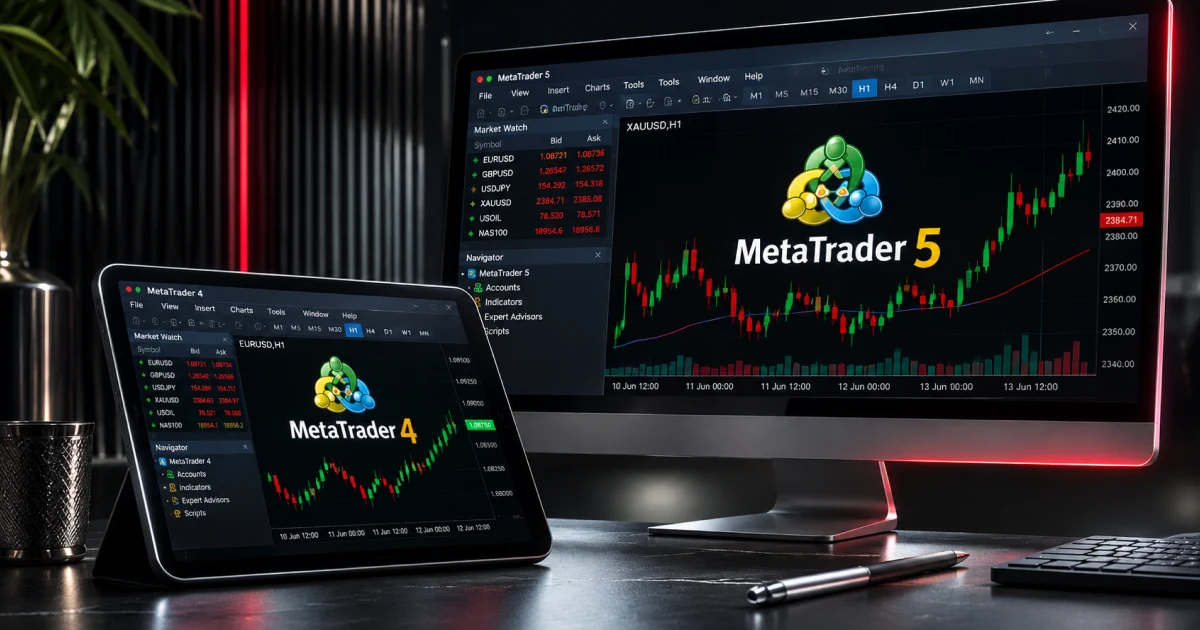
Choosing the right trading platform is an important step towards building a structured trading approach. MetaTrader 4 (MT4) and MetaTrader 5 (MT5) are two widely recognised platforms that offer charting tools, technical indicators, and automated trading capabilities. Although they share several features, their functionality, market coverage, and analytical tools differ.
Understanding these differences can help traders select a platform that matches their experience, preferred instruments, and trading strategies. In this guide, we compare MT4 and MT5, explain their key features, discuss their suitability for different trading styles, and address the legal considerations surrounding MT4 in India.
What Is the MetaTrader Platform?
The MetaTrader trading platform is a software package by the software provider MetaQuotes. MetaTrader enables traders to analyse financial markets and place orders, as well as implement and manage trading positions through a broker.
The platform family includes MT4 and MT5, each made to cater to various trading needs. They provide real-time market data, interactive charting, technical analysis, and automated trading. But the instruments, features, and trading conditions depend on the broker you choose.
MetaTrader itself is not a broker. You need to sign up with a broker that supports this platform so you can trade live.
What Is MetaTrader 4?
MT4 was released in 2005. It was and still is very popular for retail forex traders due to its simplicity. Traders prefer a minimalist trading environment with MT4, and it has an established ecosystem.
Some key features are:
- It focuses on currency trading through compatible brokers.
- Several charting options are available with built-in tools.
- Automated trading is made possible with Expert Advisors using MQL4.
- The system also allows the addition of indicators for market analysis.
- Several different types of order and position management systems can be employed.
For the older indicators, Expert Advisors, and charting setups, MT4 is still an excellent choice, though its rival MT5 is more comprehensive.
What Is MetaTrader 5?
In 2010, the MetaTrader 5 trading platform was created as a successor to MT4. MT5 added numerous enhancements to its predecessor and offers traders even more order-management and analytical tools.
Some key features of MetaTrader 5 include:
Multi-asset access: Offers users the ability to trade instruments in forex, along with instruments such as stocks, indices, and commodities when supported by their broker.
- Advanced charting: Offers 21 built-in analytical tools and 21 trading time frames.
- Economic calendar: Helps traders keep track of market changes with important trading information and events.
- Automated trading: Enables users to utilize automated trading through the support of Expert Advisors (EAs). MT5 users can also create their own custom tools through the use of MQL5.
- Market depth: Offers a Depth of Market tool, based on a trader’s broker and the asset they are trading.
- Enhanced strategy testing: With an upgraded tester, users can perform testing in multiple currencies, as well as faster and more efficient trading strategies and optimizations.
MT5 gives a much more complete package for the modern trader who wants more analysis and trading options for different types of markets and asset classes.
MT4 vs MT5: What Are the Key Differences and Which Is Better?
Swipe to compare all columns.
| Feature | MT4 | MT5 |
|---|---|---|
| Primary focus | Forex trading | Multi-asset trading |
| Programming language | MQL4 | MQL5 |
| Built-in timeframes | 9 | 21 |
| Economic calendar | Not built-in | Built in |
| Strategy testing | Primarily single-threaded testing | Advanced testing and optimisation |
| Market coverage | Primarily forex, depending on broker | Forex and other supported asset classes |
Which platform is better? For functionality, analysis, and potential for future development, MT5 clearly wins. Still, it will probably be easier to continue to use MT4 if you rely on particular MT4-based features or benefit from its more straightforward interface.
Neither platform ensures better trading performance. This will be a personal decision given user needs, broker services, and trading goals.
Why Choose MT4 Instead of MT5?
However, MT4 remains relevant for specific trading needs and goals, even with MT5's enhanced features.
1. Familiarity and simplicity
Traders who have been using MT4 for a number of years might prefer its interface and proven workflow. A familiar platform can help ease the chart analysis and order management process.
2. Existing Expert Advisors
Changing platforms could involve having to redevelop or acquire an Expert Advisor for MT5 if your trading plan relies on an MT4 version. Different programming languages: MQL4 and MQL5; make no assumptions about compatibility.
3. Set and developed indicators and community resources
MT4 has a large library of custom indicators, scripts, and trading tools. Traders who depend on particular resources may find it convenient to continue using the platform.
4. Forex-focused requirements
If you are a major currency trader and you are not interested in the extra analytical tools in MT5, then MT4 could be what you need to complete your trading routine.
But one factor that has to be taken into consideration is the availability of platforms. MetaQuotes has shifted its development focus towards MT5 and discontinued new MT4 platform licences for brokers. It is possible to keep using existing MT4 services, but the availability and support of these services must be checked with the broker.
Why Choose MT5 Instead of MT4?
MT5 is worth considering if you want a modern platform with broader analytical and trading capabilities.
1. Greater chart flexibility
Unlike most trading platforms, MT5 has 21 different trading timeframes built into it to help you analyze trading trends of all sizes and speeds.
2. Access to more markets
One of the great things about MT5 is its versatility in trading across a number of markets, including stocks and commodities, with more to come in the future, as determined by the broker you choose.
3. Advanced automation
MT5 has a very flexible language, MQL5, for advanced users to design trading systems. There are also great tools for testing your systems against historical market data.
4. Built-in Economic Calendar
Economic announcements from banks, labor statistics, and inflation data can now be followed by the trading platform.
5. Future Ready
If you want to grow outside of forex, MT5 will meet all your future requirements without you needing to switch.
Traders who are in the process of opening a new trading account need to check if the broker supports a particular platform. If it is only available as MT5, it is worthwhile for them to learn the platform first and then proceed with opening the account.
Trading Strategies: Does Your Platform Matter?
You should select your platform with your trading strategy in mind, not the other way around.
Here are three common approaches and how each platform can support them:
- Scalping: Traders aim to make profits from tiny price changes within a short timeframe. Although both brokers offer charting and order management features, the quality of execution, spreads, commissions, and lag time are highly broker- and trade-specific.
- Day trading: Day traders buy and sell the same instruments during a single day. Both terminals allow the use of indicators and several chart timeframes, while MT5 offers even more timeframes and analytical tools.
- Swing trading: Swing traders maintain positions for days or even longer. Both platforms are capable of carrying out trend analysis, support and resistance analysis, and indicator-based strategies. MT5 may be more handy given its wider array of analysis.
You can also run your robot on either platform, provided that the robot is compatible with the software.
Risk warning: CFDs and forex trading are of high risk and can result in losses that exceed your initial deposit. Leverage can work both for and against you. Please consider whether you understand this product and whether you can afford to lose it.
Is MetaTrader 4 Legal in India?
The legal status of MT4 in India is also worth pondering over since the availability of a platform and the legal licensing are two entirely different things.
MT4 is trading software, not a financial product or broker licence. A web page or mobile application may use MT4 but does not necessarily mean the broker, financial instrument, or trade is approved for Indian residents.
The RBI governs forex transactions within its jurisdiction, while securities and market intermediaries fall under the domain of SEBI. What transactions are allowed will vary given the instrument, exchange, intermediary, and rules.
Before opening an account, Indian residents should check if the broker is regulated, the specific product being offered, and whether the transaction is permitted under Indian rules. Checks against the RBI's Alert List and other official RBI and SEBI guidance can assist.
Note: This is general information and should not be construed as legal advice. Do not take it for granted that an unauthorised transaction will become authorized by using MT4 or MT5 in India. Seek the relevant regulator or legal expert's advice in case of doubt.
MT4 vs MT5 - The Final Thoughts: Which Is Better for Trading?
MT4 vs MT5: The Final Call: Which Is Better? In the end, it is all about your trading needs, instruments, and the tools you already have.
Whether you choose MT4 or MT5, MT4 is recommended if you are looking for simplicity, are mainly a forex trader, or are accustomed to using traditional MQL4 products. MT5 is usually the better choice if you are interested in more timeframes, the integrated economic calendar, or multi-asset platforms.
Is MT5 worth it? For a new trader, MT5 can often be worth it due to the platform's more comprehensive feature set and continued platform upgrades. But a trading platform is only one component of a responsible trading process. Other factors such as broker reliability, regulation, execution conditions, and risk management all merit equal concern.
About Bynix Capital: Bynix Capital is a trusted regulated forex broker that offers traders a platform to test the waters in the financial markets. Contact our experts to get familiar with the trading platforms available, the different types of accounts offered, and the trading terms and conditions. We can help you make a decision.
Frequently Asked Questions
1. Is MT4 better than MT5?
MT4 may suit forex-focused traders with existing tools, while MT5 offers more timeframes, analytical features, and multi-asset capabilities.
2. Can I use MT4 and MT5 with the same account?
Not always. Account compatibility depends on your broker, and MT4 and MT5 accounts are often separate.
3. Is MT5 suitable for beginners?
Yes. MT5 offers useful charting and analysis tools, although beginners should learn order management and risk controls first.
4. Can MT4 Expert Advisors work on MT5?
Not directly in most cases. MT4 uses MQL4, while MT5 uses MQL5, so conversion or redevelopment may be necessary.
5. Is MetaTrader 4 legal in India?
Legality depends on the transaction, instrument, broker, and applicable Indian regulations, not simply on using MT4 software.
6. Can I trade forex and indices on MT5?
Yes, if your broker offers those instruments through MT5 and their trading is permitted under applicable local regulations.