In this article
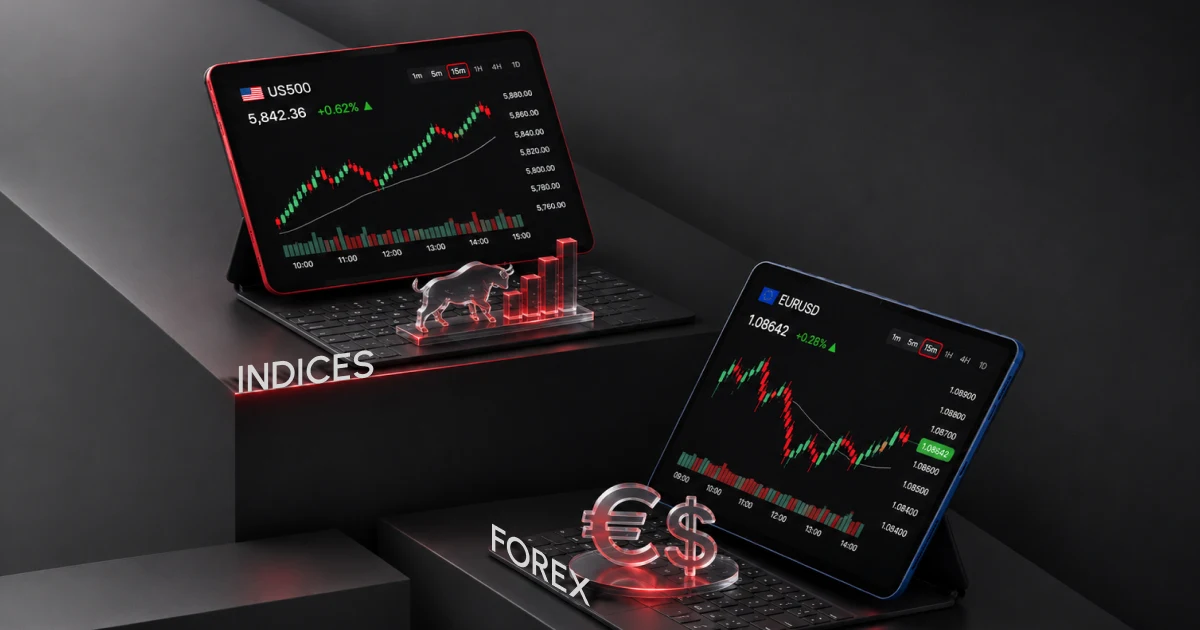
Indices vs. forex trading: When you decide to trade indices or forex, the first step should be to figure out how the market works, what influences price changes, and whether these influences align with your trading goals.
By looking at both markets side-by-side, we can see the similarities and differences in price movements, trading hours, and what factors impact pricing. The index market is a broader picture of a range of stocks, while forex focuses on currency pairs; each has its own risk factors, and both markets can open up opportunities to profit from price changes.
What Is the Difference Between Trading Indices and Forex?
The primary distinction between indices and forex trading is found in the assets traded. Forex consists of exchanging one currency for another, whereas indices reflect the performance of a group of stocks chosen based on a particular way.
FOREX MARKET traders buy or sell currency pairs like EUR/USD, GBP/USD, USD/JPY, etc. The volatility in prices can be attributed to changing interest rates, inflation, employment figures, and the monetary policies of the central bank.
Indexes still track the performance of a stock market or a section of the economy. Well-known indexes include the S&P 500, Nasdaq-100, FTSE 100 and DAX 40. Their prices are subject to company profitability, the overall economy, investor sentiment, and overall market factors.
Traders can trade either market via contracts for difference (CFDs), given the instruments available at their broker. CFDs allow traders to speculate on price movements without owning the underlying currencies or shares.
Forex vs Indices Trading: Key Differences at a Glance
Swipe to compare all columns.
| Feature | Forex Trading | Indices Trading |
|---|---|---|
| What you trade | Currency pairs | Stock market indices |
| Examples | EUR/USD, GBP/USD, USD/JPY | S&P 500, Nasdaq-100, FTSE 100 |
| Main price drivers | Interest rates, inflation, economic data, central bank policies | Company earnings, economic growth, interest rates, market sentiment |
| Trading hours | Generally 24 hours a day, five days a week | Usually linked to the relevant exchange or CFD provider's trading schedule |
| Key risk | Currency fluctuations and leveraged exposure | Market-wide declines and leveraged exposure |
| Analysis | Currency fundamentals, technical analysis, economic calendars | Economic data, company performance, sector trends, technical analysis |
Although both markets respond to economic developments, the way those developments affect prices can differ significantly.
What Are the Similarities and Differences Between Forex and Indices Trading?
Although they can both be used for speculation on the same type of activity, Forex and Indices markets are distinct. There are four similarities worth noting when it comes to Forex and Indices markets.
1. Both allow speculation on price movements
Long and short positions are available for traders on the assumption that prices will rise or fall. When speculating on the Forex or Indices markets through a CFD provider, it is not required that the trader hold the asset itself.
2. Both use technical analysis
Techniques such as support and resistance lines and trend lines, along with moving averages and indicators, can all be used in analyzing price movements in both markets.
3. Both respond to economic developments
Macro events like economic announcements and reports have an impact on currencies and the stock indices. These announcements can include employment numbers and inflation data, along with other reports.
4. Both involve financial risk
It is easy to gain exposure to the markets through leverage, but it’s just as easy to lose everything without the necessary tools for managing the risks.
Differences Between Forex and Indices Trading
1. Market focus
In Forex trading, the relative value of two currencies is the focus. Indices trading involves trading the overall performance of selected companies or a specific portion of the stock market.
2. Factors influencing prices
The differentials in the conditions and monetary policies of countries significantly influence the prices of currencies. Other factors like corporate profits, sector performance, and investor confidence can also affect indices.
3. Market behaviour
Sometimes, the Forex pairs react differently based on the currency pair. Indices can trade significantly higher or lower when investors change their outlook on the economy, corporate profitability, or market risk.
4. Trading schedules
The forex market is open on trading days in all the world's financial centres. Although index trading hours vary according to the underlying market and instrument specifications of the broker, some index CFD programs provide extended hours.
These differences can guide traders in selecting markets that fit their trading schedule, strategy, and risk preferences.
Is Indices Trading or Forex Trading Better for Beginners?
Neither market automatically suits a beginner better than the other, and the choice hinges on how much you grasp about each, the hours you can dedicate, your comfort with risk, and your desire to build knowledge.
Forex tends to attract those who want to dig into currency relationships and track economic calendars. Observe how central bank decisions shake exchange rates. Major pairs often draw newcomers because they pull heavy participation, though their prices can still spike in unexpected ways.
Indices might fit those who would rather follow broad stock trends than untangle the web of individual currency factors. The Nasdaq-100 lets you track large non-financial companies listed on that US exchange. The S& P 500 bundles together major US firms into a single view.
Still, indices can gap suddenly and swing sharply around earnings reports, economic releases, and surprising headlines. Forex is not immune either. Big announcement times can whip markets into turbulence fast.
The simplest path forward for beginners is mastering one market at a time. You can open a demo account and practice reading price moves. Get familiar with costs and risks before you put real money on the line.
Risk warning: Trading forex and index CFDs carries real danger. Relies on leverage and amplifies losses, and you stand to lose some or all of the capital you invest. Only use money you are fully prepared to part with.
How Can You Trade Indices and Forex?
The process is a bit the same, but the instruments used are different in these markets.
Step 1: Choose a Suitable Broker
Choose a trusted and regulated broker who provides the trading instruments you are interested in. Check its regulation, trading hours, spreads, commissions, roll charges, and available platforms prior to opening an account.
Step 2: Understand the Instruments
In Forex, understand the concept of currency pairs, base and quote currencies, spread, and pip movement. Learn about indexes; know the meaning of an index, its hours of trading, the contract specifications, and the factors that affect the price of an index.
For CFD traders, be sure to review the contract size, margin and leverage limits, and any applicable overnight fees.
Step 3: Analyse the Market
Apply basic and technical analysis to find trading opportunities.
Forex: Watch economic news, interest rate decisions, inflation reports, and employment data. When looking for indices, watch company earnings, economic growth, market sentiment, and key events on the stock market.
Technical analysis can be used to supplement this research to help identify trends, entry points, and possible resistance and support levels.
Step 4: Develop a Risk Management Plan
Before you start trading, determine the amount of risk you have allowed yourself on each trade. Try to utilize stop-loss orders, position sizes that are appropriate, and don't go over-leveraged.
Don't gamble with money just because a trading opportunity looks good. It's better to stick with a consistent method of loss management rather than attempting to take advantage of every market change.
Step 5: Practise and Review Your Performance
Practise your trading and managing positions in a demo account across various market conditions. Maintain a trading journal to document your trading motivations, results, and what you learned.
When you have an understanding of how the strategy has worked, regularly check your strategy and adapt it based on evidence rather than emotion.
Factors to Consider Before Choosing a Market
Here are several things to consider before deciding between trading forex and indices.
- Knowledge and experience: Choose a market where you can understand and easily follow the trends.
- Trading schedule: Choose a market where the trading hours fit your trading plan and schedule.
- Volatility: Understand how rapidly prices can move, and how this affects your potential gains or losses.
- Trading costs: Review and compare all of the costs and charges for trading in each market (spreads, commissions, fees).
- Risk tolerance: Determine how much capital you can afford to risk by sizing your trades and determining the level of leverage to use.
- Trading strategy: Determine what you believe will affect the market most. Is it the relationship between currencies, or the broader market trends, or the movement of price in the short or long term?
There are no markets that guarantee profit. Knowledge building, trading with consistency, and sticking to a plan will enable you to trade with increased accuracy.
Indices vs Forex Trading: Key Takeaways
Daily market analysis for Forex, indices, commodities, and more! Forex and indices can both be traded to profit from the market, but they offer different choices for a trader, and both require an understanding of what causes their prices to fluctuate.
Forex centers on currency pairs and the economic connections between nations. Indices represent the performance of specific groups of stocks and are influenced by corporate earnings, economic outlooks, and investor sentiment.
Both markets can be technically analysed, provide opportunities to go short or long via CFDs, and are both extremely risky when leverage is used.
Beginner investors should focus on the market that they are most familiar with, that they are most comfortable analysing, and that they are able to control their investment wisely. Be smarter than the temptation to select based on return alone.
Market traders can trade the financial markets through the trading instruments and the trading support at Bynix Capital. Contact us to gain valuable insights into trading opportunities in different markets, the trading conditions, or any other information that you require.
Frequently Asked Questions
1. What are the key differences between forex trading and indices trading?
Forex involves currency pairs, while indices trading involves speculating on the performance of a group of stocks.
2. Which market offers the best trading opportunities: forex or indices?
Forex and indices trading each offer their own unique set of opportunities and challenges. No trading market is inherently better. The choice will be dependent on how much trading knowledge and experience you have. As well as the trading strategy and the trading style that you plan to implement and, most importantly, the level of risk you are willing to accept.
3. Do beginner traders get the option to trade forex and indices?
Yes, beginners can learn both markets using educational resources and demo accounts before risking real money.
4. Can I use CFDs to trade forex and indices?
Many brokers offer forex CFDs and index CFDs that traders use to speculate on the prices of assets without owning them.
5. What market is more volatile, forex or indices?
The level of volatility depends on many factors, such as the currency pairs, the specific index, and the current market conditions. No market is consistently more volatile.
6. What is the greatest risk of trading forex and indices?
In both markets, leverage significantly increases potential losses. Sharp changes in prices, poor risk management, and holding too large a position size can increase the probability and the potential size of losses.