In this article
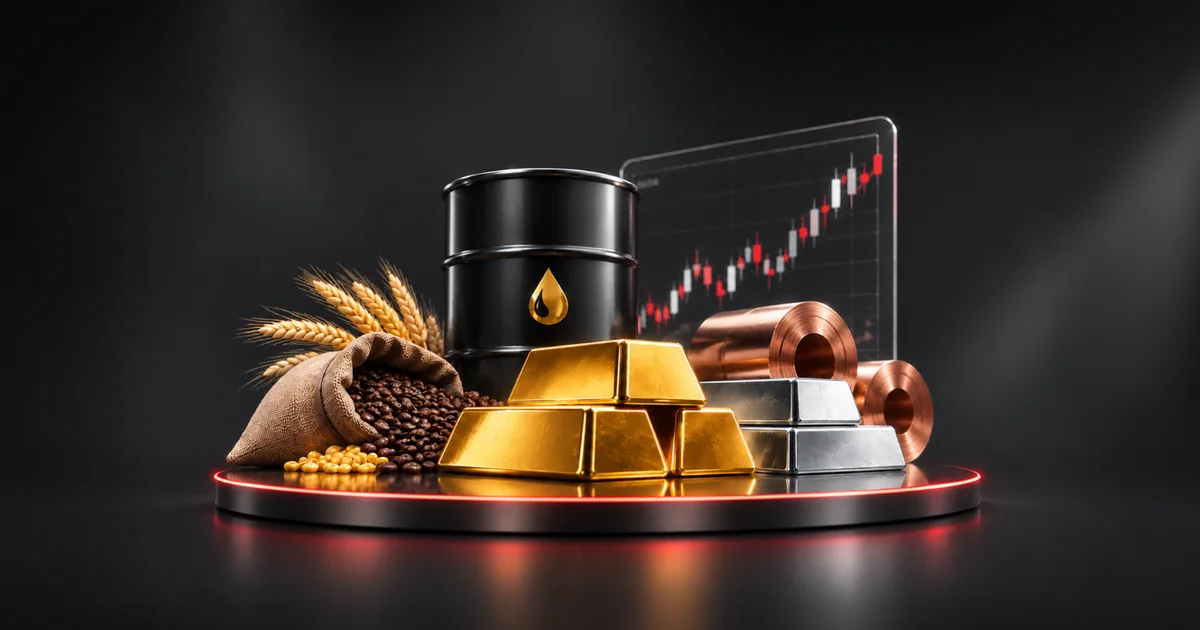
What is commodity CFD trading? Commodities are raw materials such as gold, silver, crude oil, natural gas, coffee, copper, and palladium, with prices influenced by supply and demand, geopolitics, and weather. Instead of making direct investments in physical commodities, commodity CFD trading involves speculating on the future price of these commodities without ever taking delivery of them.
Traders who want to speculate on commodities can trade CFDs on their existing trading platform without needing to purchase barrels, ingots, or shares, providing the trader with access to global markets, the ability to trade on rising and falling markets, and flexibility for their trading schedule.
What Is Commodity CFD Trading?
Commodity CFD trading: what you need to know. What is commodity CFD trading? Commodity CFD trading is a means by which an investor can trade CFDs (Contracts for Difference) on natural resources and raw materials.
With CFD trading, investors do not need to buy, store, or deliver the underlying asset when trading commodities. It is merely the price difference (minus any fees), between the open and close price of the position that earns or loses the investor money.
For instance, if a trader anticipates an increase in the value of gold, they would enter into a buy position for a gold CFD. If the value of gold increases, a trader's position may turn a profit. If the price of gold drops, a trader may suffer a loss.
Gold, crude oil, and energy commodities CFDs include precious metals, energy products, and various agricultural commodities. Crude oil and gold CFDs are among the best known because they are a reflection of international economic growth, supply, and demand, and geopolitical factors.
How Does Commodity CFD Trading Work?
The basic idea of trading Commodity CFDs is to trade the price fluctuations of commodities, not trading the actual physical commodity.
It works like this:
- Select a commodity: Take a look at all available instruments and decide on the one that fits your research and your goal. ( Gold, Silver, Oil, Gas, etc.)
- Do a market analysis: Take a look at all economic factors, current news, and price charts, and anything that can impact the price of your commodity.
- Decide whether you should buy or sell: In this market, you should sell if you believe that the price is going to fall, and buy if you believe that it's going to rise.
- Decide the size of your trade: As you prepare your risk management, decide the size of your trade, which is proportional to the size of your available margin.
- Monitor your position: When your trading strategy and risk limit warrant a change in your position, do it.
Trading CFDs involves trading using a margin, where the margin is a smaller percentage of the value of the trade than the total value. While leverage gives you the chance to open a position that is bigger than your capital, it increases your market risk and magnifies your losses.
How to Trade Gold CFDs
Gold is one of the more active commodities for traders. Inflation expectations, interest rates, currency markets, and geopolitical events will all cause the price of gold to move. As economic conditions shift, gold prices will react.
Before you start learning how to trade gold CFDs, you will need to understand what causes the gold market to move and how it connects with other financial markets.
- Keep up to date on economic events: Gold prices can move quickly when central banks change policies and inflation, employment, and other data reports are published. In addition, changes in the value of the dollar will also impact gold prices.
- Study Price Charts: Technical analysis, including the use of support and resistance lines and levels, trend lines, and momentum indicators, helps traders understand the potential for profit in the markets.
- Choose your trade: As gold prices trend either up or down, the corresponding trading positions for gold CFDs are buy and sell, respectively. However, trading is never without the potential for loss.
- Control your risks: Use position sizing and set a stop loss on your trade to manage your exposure. Remember, gold trading is not without risk, and you must manage your capital accordingly.
While gold CFD trading can provide some advantages over other gold trading instruments, for example, eliminating the requirement of gold ownership and storage, it should still be approached with caution by the gold trader due to the market’s unpredictable volatility and potential for swift changes.
Understanding Crude Oil CFD Trading
Crude oil is one of the more significant items of trade in the world of financial markets. Its prices vary according to demand for energy, the levels of production, inventory, and transportation disruptions, and finally, developments of a geopolitical nature.
Oil CFDs are a convenient instrument for trading in the oil market.
There are some important factors that one should keep in mind while studying oil markets.
- Global Supply and Demand. This means that a change in production or consumption of oil would disrupt the oil balance.
- Decisions of the OPEC+. Policy announcements and the decisions of oil-producing countries regarding production also affect oil markets.
- Inventory Reports. It is possible to estimate the short-term supply and demand of oil with the help of reports regarding changes in inventory.
- Geopolitical Situations. Sudden price fluctuations can happen because of war, sanctions, and disruption of transport.
Brokers offering the crude oil trading instrument will differ. Some contracts can reference either Brent or West Texas Intermediate (WTI). Other conditions of trading could also vary.
It is very important for the trader to first understand the terms of the crude oil contract the broker offers before opening a position.
Commodity CFDs vs Forex Trading: What Is the Difference?
Traders can speculate on price movements in these two trading methods, which is known as commodity trading and Forex trading, without actually owning the commodity or foreign currency. The characteristics of the markets, however, vary in their driving forces and how instruments are quoted.
- Underlying market: Commodity CFDs track assets like gold, silver, and crude oil. Forex trading is about trading one currency against another, like EUR/USD or GBP/USD.
- Price influences: Commodity prices are affected by supply and demand, production, inventories, and global events; these are called price influences. Interest rates, economic activity, inflation, and monetary policy, among other factors, affect Forex prices.
- Market movement: Commodities may move quickly in response to events such as a disruption in supply or a geopolitical event. Economic data and central bank statements can have a significant impact on currency pairs.
- Trading opportunities: This will depend on the conditions both markets offer in terms of growth and decline opportunities with CFDs, depending on the instruments and account specifics available.
Both markets are not easier or safer to trade. The right one is the one that suits you best and that you imagine you will be able to reach your goals with. The right one is the one you think you'll be able to achieve your goals with and the one that you know your market.
Benefits of Commodity CFD Trading
Commodity CFDs allow traders to take positions on global markets.
Different markets can be explored in one trading account. This can include precious metals and commodities.
Traders are not required to hold a physical commodity. With CFDs, there is no requirement to store, deliver, or physically hold a commodity.
Depending on the instrument and trading account, traders are allowed to take either buy or sell positions.
Using leverage in trading allows exposure to a larger market with a smaller margin but increases the risk of trading.
Analysis of commodity markets offers insight into various market and trading factors, including the economy, the fundamentals, and technical factors.
Traders must account for trading costs, volatility, and uncertainty when assessing risk to avoid a potential loss.
Risks to Consider Before Trading Commodity CFDs
Trading CFDs on commodities is highly risky and can result in significant financial loss, mainly where the leverage offered by the provider is used. Prices can be extremely volatile in commodity markets, mainly in the wake of an economic data release, geopolitical event, or supply/demand shock.
Trade leverage can amplify your returns and losses, and adverse price movements can bring significant losses. According to your broker and account type, you could pay spreads, financing overnight costs, slippage, and other charges.
So risk management should be included in any trading plan. An individual trader can think about including stop-loss limits, controlling the size of the position, not taking on too much leverage, and reducing the amount of risk they are taking on by regularly reviewing their position. Not all stop-loss orders will fill at their requested rate in volatile market conditions or gaps.
Risk Warning: Contracts for Difference are complex, high-risk products and come with a high risk of losing money rapidly due to leverage. You should consider whether you understand how CFDs work and whether they are appropriate for you.
How to Choose a Commodity CFD Broker
There is more to consider than just asset type and direction when you enter the trading arena. The following is a quick checklist of things to look for in a trading broker before you fund your account.
- Is the broker authorized by the regulatory body where they claim to be licensed?
- What are the broker’s trading costs (i.e., what spreads and/or commissions are you paying to hold the trade, overnight or over an extended period)?
- Are the commodity CFDs offered by the broker in line with your trading objectives?
- Does the broker provide a quality, easy-to-use, feature-rich trading platform that supports quality execution and analysis?
- What protective measures, if any, can be put in place to help you manage your downside risk?
- What is the availability and responsiveness of the support offered to clients when things go wrong?
Bynix Capital provides access to forex and CFD trading services, giving traders a platform to explore available financial markets. Before opening an account, review its regulatory information, product specifications, fees, and applicable client terms to ensure they meet your requirements.
Conclusion
Trading commodity CFDs is a good way to gain exposure to markets like gold, oil, and other commodities without having to take on the bother of an actual holding. With the right focus on markets, risk, and trading costs, traders will be better equipped to work with these products.
While you're looking for how to trade gold CFDs or are exploring a few details of crude oil CFD trading, you need to get ready to trade. Always research your facts before risking your cash and know what is involved, including leverage and margin requirements.
Interested in trading commodities CFDs? Contact our professionals to discover which instruments we offer for trading, our platform's capabilities, and other trading accounts. Stay well-informed, understand the risks, and pick a solution suitable for your needs and capital.
Frequently Asked Questions
What is commodity CFD trading?
This trading involves speculative commodity price action, with the owner not actually owning the commodity itself.
Can I trade gold without buying physical gold?
Gold CFDs let the owner trade the price action of gold without buying gold.
How does crude oil CFD trading work?
Traders open a long (buy) or short (sell) position and will profit or lose based on price changes after their entry.
What is the difference between commodity CFDs and forex?
CFD commodities trade the movement of goods such as oil and gold. Forex trades involve currencies.
Is commodity CFD trading risky?
There are definitely risks with Commodity CFDs, such as leverage and market volatility, which can amplify your losses in the market very quickly.
How much money do I need to start trading commodity CFDs?
The investment amount required will depend on your broker, account type, the margin, and the conditions of trading at that moment.